The 2026 AI / AEO Optimisation Checklist for Wraparound Care and Holiday Club Providers.

Is your out of school care programme invisible to AI?
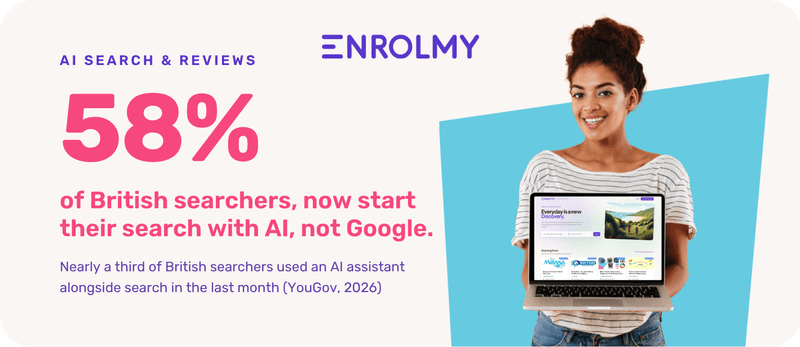
A year ago, 31% of UK adults were using AI tools like ChatGPT, Copilot or Gemini. Today that figure is 54%, according to Ofcom's 2026 Adults' Media Use and Attitudes report, and among 16-24 year-olds, it's 79%. Layer on YouGov's 2026 Great Britain Web Search and AI Report research and the picture sharpens further: nearly a third of British searchers used an AI assistant alongside a normal search engine in just the last month, and 58% now sometimes open their search with AI instead of Google.
So ask yourself one question: if a parent typed "a good sports holiday club near me" into ChatGPT or Google's AI mode this week, would your name be in the answer?
For most school aged childcare providers, it wouldn't. Not because your programmes aren’t brilliant, but because the information AI needs to recommend you isn't sitting anywhere AI can actually read it. That's a fixable problem, and most of the fix takes an afternoon, not a rebuild.
Checkout these helpful AI tips and checklist for wraparound care and holiday clubs to get sorted before September.
What "AI-readable" actually means
Think about how you'd describe your afterschool club to someone over the phone who's never seen your website. You'd tell them the age range, the time, the price, maybe what to bring. Simple, spoken, plain. That's exactly the version an AI needs and it's usually not the version sitting on your site.
Most children’s activity websites are built for a parent with a mouse, not a machine reading code. A parent will happily click "Book Now", wait for the widget or PDF to load, and scroll through a photo gallery to find the good bits. AI doesn't do any of that. It scans the page, looks for facts it can lift word-for-word.
Three habits are usually the culprit:
Your key details only exist inside downloadable PDF’s or DOCs or gated pages. Ages, times, prices, all real, all correct, but all sitting behind downloadable file types or locked up systems with no marketplace. AI can’t access these easily, if at all.
Your details are a picture, not text. That polished holiday club timetable on Canva looks great to a parent. To a machine, it's a blank rectangle with no words in it.
Your descriptions are written for vibes, not facts. "Fun for the whole family!" tells a machine nothing. "Ages 4–11, Saturdays 9–10am, £8 per session" tells it everything.
Fix those three and you've done most of the job. This isn't a website rebuild or requires a developer, it's taking information you already have and putting it somewhere in plain writing, so both the parent and the AI answering her question can actually read it.
Try this right now: ask the AI about yourself
Do the two minute test that tells you more than any audit. Open ChatGPT or Gemini and type the exact question a parent in your area would ask, "best wraparound care near [your town]" or "fun football classes for 5 year old near [your postcode]." See who comes back.
Do this once a term. YouGov's research found that 71% of existing AI users already say they use it more than they did a year ago, and almost half expect to lean on it even more over the next twelve months, this is a fast-moving picture, and showing up today is no guarantee you'll show up in October. Those who check quarterly catch the gaps early. Providers who never check just quietly stop getting the enquiry, with no idea why.
The bit everyone skips: FAQs, more places, and reviews that don't go stale.
Once your core details are readable, three smaller habits do alot of the work.
Write FAQs that answer what parents actually ask, in their words, not yours.
AI tools lift question-and-answer content almost verbatim, so the closer your FAQ matches the exact phrase a parent types, the more likely you are to be the answer. A few that consistently work well for activity providers:
"What age can my child start [activity]?"
"Do you offer a free taster or trial session?"
"What should my child wear or bring?"
"What happens if we miss a session, do you offer catch-ups or refunds?"
"Do you accept Tax-Free Childcare or HAF vouchers?"
"Do you run during school holidays and half-terms?"
"Can I pay weekly, termly, monthly, or per session?"
"What's your cancellation policy?"
Easy ways to find FAQ’s more specific to your organisation are reading through your parent emails and texts to find what they’ve been asking recently.
Notice none of these are written to sound clever. They're written to sound like the exact sentence a tired parent types at 9pm. That's the whole point.
Show up consistently in more than one place and utilise the free platforms expertly.
AI cross-references multiple sources before it trusts a recommendation enough to make one. Worth covering, in order of effort:
Your own website, kept current.
Your Enrolmy Marketplace listing, already structured, already public, already doing the machine-readable heavy lifting for you.
Your Google Business Profile.
Your Facebook, Instagram and LinkedIn business pages, free, and AI tools do pick up business details, opening information, and reviews posted there.
Your local authority's Best Start Family Hub directory, if your council runs one. Many UK local authorities now maintain a family hub or "Best Start" listing of local childcare and activity providers, worth checking whether yours does, and registering if so.
Keep reviews coming in, and keep them recent automatically, not by memory.
UK consumers rate customer reviews (78%) and star ratings (72%) as either "very useful" or "useful" when deciding who to book with, according to Trustpilot's UK-focused London Research study, reviews are not a nice-to-have here, they're doing real work in the decision. And the same pattern that shows up in every reviews study, UK or otherwise, holds true: a handful of old five-star reviews from three years ago carries far less weight than a steady trickle of fresh ones from this term, and having plenty of reviews rather than just a couple matters more than most providers assume.
The easiest fix here isn't a New Year's resolution to "ask for more reviews.” It's automation.
Set up a review request email that goes out automatically at the end of every term, to every family, rather than relying on remembering to ask. If you're active on more than one review platform, drip feed them rather than asking for everything at once: Google reviews after autumn term, Facebook after spring term, your Enrolmy Marketplace reviews after summer term, then start the cycle again. It spreads fresh reviews across every platform AI might check, instead of one platform going stale while another gets all the attention.
It's also worth remembering that AI isn't replacing Google so much as sitting alongside it for now, nearly a third of British searchers are already using both in the same month, per YouGov Research. Which means the reviews and details you keep fresh for a parent's Google search are doing double duty for the AI she might ask next. Optimise for one and you're quietly optimising for both.
Where this shows up differently depending on what you run
The fix looks slightly different depending on your programme type:
Wraparound care and before clubs and afterschool clubs. Parents searching for you are almost always hyper local and time pressured, "breakfast club near [school], starts 7:30am." Your pickup times, exact school partnerships, and HAF or Tax-Free Childcare compatibility need to be plain text a machine can lift, not a phrase buried in a PDF parent handbook.
Holiday programmes and camps. Search spikes happen in short, predictable bursts before each school holiday, which means your dates, age bands, and daily structure need to be live and accurate weeks before half-term, not updated the week it starts. An AI recommending "summer camps in Lewisham" needs to see current dates, not last year's.
Lessons, classes, and sports clubs. These searches are the most specific of all, a level, an age, a day, a location. "Grade 2 ballet, Tuesdays, ages 7–9" is something an AI can quote confidently. "Classes for all abilities, enquire within" is something it will skip straight past in favour of a competitor who spelled it out.
Music schools and performing arts. Parents here often search by instrument, grade, or exam board, "Grade 3 piano teacher near me" or "drama classes leading to LAMDA exams." If your listing doesn't mention the specifics (instruments taught, exam boards, ensemble opportunities), an AI has nothing distinctive to recommend you on, even if you're the best teacher in the area.
STEM and coding clubs. These searches skew toward outcomes parents care about, "coding club that teaches Scratch" or "robotics club ages 8–12, no experience needed." Naming the actual tools, languages, or kit you use in plain text gives an AI something concrete to match against the question.
Franchises and multi-setting operators. Each of your venues needs its own accurate, plain-text listing, a parent (and an AI) searching for "your brand, Guildford" doesn't want a generic head office page with no local specifics. Consistency across venues matters just as much as accuracy within one, since AI will happily recommend your Guildford site and skip your Woking one if the Woking listing is thinner.
Whatever you run, the underlying fix is the same: plain text, current information, real reviews, answered questions.
Where the Enrolmy Marketplace already has your back
Here's the good news if you're already running on Enrolmy: a meaningful chunk of this work isn't something you need to build from scratch, it's something you're likely already sitting on.
Every activity listed on the Enrolmy Marketplace publishes as plain, crawlable text for AI, name, provider, age range, schedule, location, price, not locked behind a login or a booking widget click. That's the exact "machine-readable, not hidden away" requirement every AI search guide out there is currently telling businesses to go and build.
It also quietly solves the "show up in more than one place" problem. Your Marketplace listing sits alongside your own website as a second, consistent public source describing the same activity, already carrying a Verified Provider badge and built to gather your reviews in one spot, rather than scattered across five platforms you'd otherwise have to manage by hand.
Enrolmy won’t write your FAQs for you, and it won't ask your families for reviews, that part's still on you. But if your Enrolmy Marketplace listings are complete, current, and gap free, you've already banked a real chunk of the AI-readiness work the rest of the sector is only just starting to catch up on.
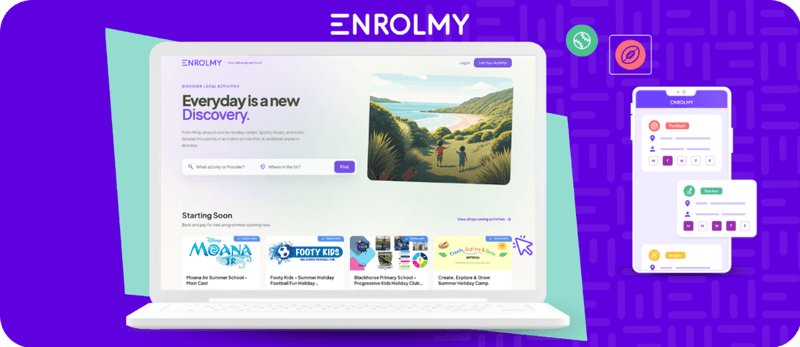
Talk to our team about listing your activity on the Enrolmy Marketplace or looking into Enrolmy as your full booking, payments and subsidies management software and listing place.
Your AI Optimisation Checklist
Print this bit out, stick it on the office wall, and tick each one off before the next intake conversations start:
Audit your listings. Check that class times, ages, and prices appear as visible text on your website, not only inside a booking widget or a timetable image.
Rewrite the vague bits. Replace any "fun for all ages, enquire within" copy with the actual facts: exact ages, days, times, and prices.
Create (or fix) your FAQ. Add real, parent phrased questions and answers to your website and your Enrolmy Marketplace listing, start with the eight examples above.
Check your Enrolmy Marketplace listing. Make sure every activity is live, current, and gap free, this is your fastest win, since the structure is already built for you.
Set up your social pages properly. Confirm your Facebook, Instagram and LinkedIn business pages have current hours, location, and contact details, not just nice photos.
Check for a local Best Start family hub directory. Search your council's website and register your provision if one exists.
Set up an automatic termly review request email. Don't rely on remembering, automate it, and rotate which platform you point families to each term.
Run the ChatGPT test. Search for your own business the way a parent would, on both ChatGPT and Gemini, and note what comes back.
Put a date in the diary to do it all again. Once a term, minimum, AI recommendations shift as fast as your review profile does.
Download the checklist below.

Nine items, one afternoon. Unlike most things worth fixing in this industry, this one won't eat your summer but skipping it could quietly cost you your busiest term.
Frequently Asked Questions
What is AEO?
AEO stands for Answer Engine Optimisation, the practice of structuring your information so tools like ChatGPT, Gemini, Perplexity and Google's AI Overviews can find it, understand it, and quote it back to a parent as a direct answer. Where SEO has spent twenty years getting you onto page one, AEO is about getting you into the answer itself, sometimes without the parent ever clicking through to a website at all. You might also see it called GEO (Generative Engine Optimisation), same idea, different acronym, and the two terms are used pretty interchangeably right now.
What's the difference between AEO and SEO, do I need to do both?
Yes, do both, they're not competing jobs. SEO is still what gets your website found and ranked in a traditional Google search. AEO is what gets your specific class times, prices and ages lifted out of that page and used directly in an AI-generated answer. The good news is they overlap more than they conflict: plain, accurate, well-structured information helps both. Everything in this checklist, readable text over images, clear FAQs, live reviews, is good for classic SEO too. Think of AEO as SEO's more literal minded younger sibling: it doesn't care about clever headlines, it just wants the facts, clearly stated.
What is schema markup, and do I need to add it myself?
Schema markup is a bit of behind the scenes code (you won't see it, but search engines and AI tools do) that explicitly labels information on your page, "this is a price," "this is an age range," "this is a review," rather than leaving a machine to guess from context. It's one of the more technical pieces of AEO, and it's genuinely one you can hand off. If you're listed on the Enrolmy Marketplace, this structure is already built into how your listing publishes, you don't need to touch a line of code for that part. For your own website, it's worth asking your web developer or website platform whether they support schema for events, FAQs and reviews, most modern website builders do, it's often just a setting to switch on.
What's an "llms.txt" file, and do I actually need one?
You may have come across this term while reading up on AI visibility, it's a proposed plain text file that sits on a website and tells AI tools where the important information lives, a bit like a signpost. It's worth knowing the name, but not worth losing sleep over: it's still an unofficial, contested standard, Google's own Search team has said publicly it isn't required, and as of mid-2026 fewer than 6% of major websites have one. Put simply, it's a nice to have some developers are experimenting with, not a checklist item that will make or break your AI visibility. As of right now, everything else in this article matters far more.
Which AI tools should I actually be checking, ChatGPT, Gemini, Perplexity, Google AI Overviews?
All of the above, but start with ChatGPT and Google's AI Overview (the summary box that now often appears above normal Google results), since those two have the widest reach with UK parents. Gemini and Perplexity are worth a quick check too, particularly if you're in a franchise or multi-site setup where visibility gaps show up differently tool to tool. You don't need a fancy monitoring tool for this, the "ask the AI about yourself" test earlier in this checklist, done once a term, covers it.
Will optimising for AI hurt or help my normal Google search ranking?
Help, not hurt. There's no such thing as "optimise for AI at the expense of Google" here, the two are converging, not competing. Everything this checklist asks you to do, readable plain-text details, real FAQs, fresh reviews, consistent information across your listings, is also exactly what improves a normal Google search result.
Do I need to hire a developer or an agency to do this?
For almost everything in this checklist, no. Rewriting vague copy into plain facts, building an FAQ, requesting reviews, checking your Enrolmy Marketplace listing, none of that needs technical help. The one item that occasionally benefits from a developer's ten minutes is schema markup on your own website, and even that's often a toggle in your website platform's settings rather than custom code. If in doubt, tackle everything except schema yourself first, it's most of the value for none of the cost.
How quickly will AI actually start recommending my business?
There's no fixed timeline, AI tools crawl and retrain on different schedules, and some update their understanding of a business faster than others. What we do know is that showing up today is no guarantee you'll show up next term, and providers who never check simply stop appearing with no warning. Treat it like reviews: an ongoing habit rather than a onevoff fix, and check in on yourself once a term using the ChatGPT test above.
I don't have a website, just a Facebook page, does any of this still apply to me?
Yes. Facebook and Instagram business pages are read by AI tools too, so the same principles apply: fill in your hours, location and contact details properly, keep your "about" description factual rather than just vibes, and ask for reviews there consistently. Getting listed on the Enrolmy Marketplace also gives you a proper structured web presence without needing to build or maintain a website of your own, worth doing regardless of whether you ever get around to a full site.
Is this a one-off job, or something I need to keep doing?
Ongoing, sorry, this isn't a "tick it off forever" checklist. The good news is that after the first proper pass, most of it is maintenance rather than a rebuild: a fresh review request each term, a quick ChatGPT search of yourself each term, and updating dates and details whenever they change. Put a recurring date in the diary now and future you will thank present-you in September.
Book a free demo now!
It only takes a few clicks to get started
Book DemoWe’d love to show you all the ways Enrolmy can serve you. Make it easy and superpower all you do.