2026 Ofsted Inspection Checklist for Wraparound Care Providers
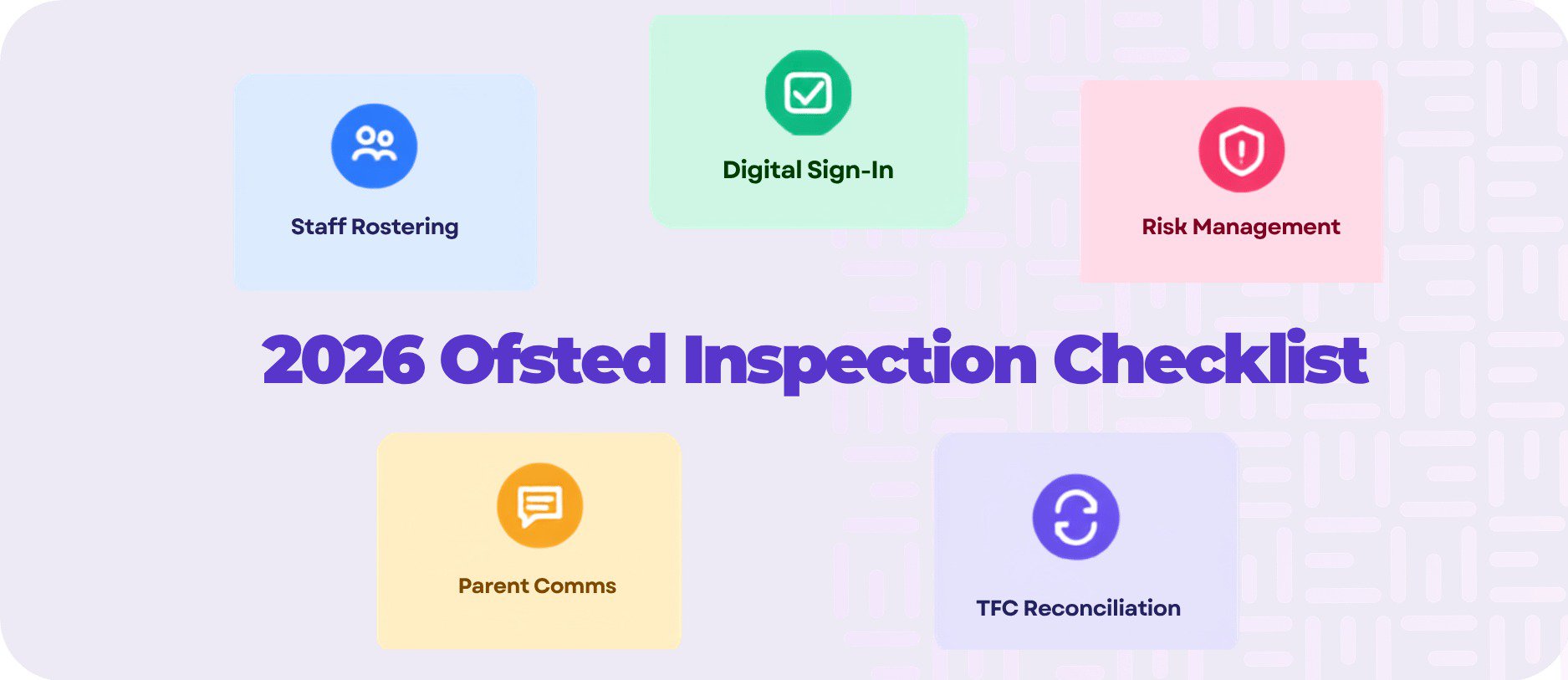

Running a wrap-around-care provision is demanding work. You’re managing drop offs before most people have finished their first coffee, keeping children safe and engaged across breakfast clubs, afterschool sessions, and holiday clubs, and somehow holding it all together with a team of childcare providers that stretches across term time and beyond. The last thing you need on top of that is an Ofsted inspection catching you off guard. This guide isn’t here to add to the anxiety. Instead, it gives you a practical, sector specific checklist to work through before an inspector arrives, along with context on why 2026 is a particularly important year to make sure your evidence is in good shape.
Running childcare services that spans multiple settings or requires dozens of staff? Enrolmy's child safety compliance tools, including digital attendance sign-in, risk management, incident logging, and staff rostering, are designed to keep evidence organised without adding to your admin load. Explore the full feature set →
Why 2026 changes the inspection landscape
Two major changes are shaping inspection expectations this year.
First, the Government's National Wraparound Childcare Programme Handbook set out a £289 million investment to expand wraparound care provision, with the aim that all state primary schools in England can offer wraparound care from 8am to 6pm by September 2026. As provision is utilised, the scope of Ofsted scrutiny and standards increases across the board, both for new settings entering the system and for existing school age childcare operators.
Secondly, for school led provisions; Ofsted has been updating and rolling out the way that they score, consulting on replacing its single word judgements: ranging from Urgent Improvement to Excpetional, with a more detailed report card framework. Implementation began in 2025. A school that could previously rely on a comfortable and vague "Good" may find inspectors probing areas that were not previously scrutinised in detail. With the rise in school led childcare provisions inline with the government funding, it is imperative to be aware of the school Ofsted standards and looking to develop even more robust compliance and safety checks as a private-led provider provision. Even though right now there are differences between the Ofsted requirements for differing provision types, very quickly, parent expectations will rise to match those marketed to them as ‘safer’ more ‘compliant’ and in line with the latest child health and safety and regulatory standards.
Finally with around 44% of children aged 5–11 using formal childcare in 2024, and more to come with funding schemes available to utilise, parents are increasingly sophisticated consumers of childcare quality, and Ofsted results are becoming more visible. Your inspection record matters commercially, not just regulatory.
What Ofsted looks for in wraparound care settings
Ofsted inspects out-of-school childcare settings under two registers depending on the age of the children you work with. If you care for children under school age, you will be on the Early Years Register. If you care for children aged 5 to 7 who are no longer in early years provision, you are on the Childcare Register. Many wraparound providers operate across both.
Regardless of register, inspectors focus on four core areas:
Safeguarding: the robustness of your policies, the quality of your training, and whether your Designated Safeguarding Lead (DSL) is confident and appropriately trained and equipped to act on concerns.
Quality of care and education: whether children are engaged, safe, and well supported throughout sessions.
Leadership and management: whether there is clear oversight, consistent staff development, and a culture of ongoing improvement.
Partnerships with parents: how effectively you communicate, share information, and respond to concerns.
Evidence is everything. An inspector can’t judge what they can’t see documented. The checklist below is built around that principle.
Want to automate compliance requirements within your setting/s as much as possible? See how attendance, enrolments, incident reporting and staff scheduling compliance tools inside Enrolmy can handle all of this for your organisation→
Your 2026 Ofsted inspection checklist
Review these areas before your next inspection. For each one, the question is not just, "Do we have this?" but, "Could we easily show an inspector exactly where it is and how it is kept up to date?"
1. Safeguarding policy: current, signed, and embedded in daily practice
Your safeguarding policy should be reviewed and resigned at least annually, and whenever statutory guidance changes. Every member of staff must have read and understood it, and know exactly how to report a concern in practice, not just in theory. Your Designated Safeguarding Lead (DSL) should be clearly named within the policy, and you should be confident they have completed appropriate refresher training within the last two years. Inspectors will also speak directly with staff during visits to check understanding of safeguarding procedures. This means verbal knowledge alone isn’t enough, it needs to be backed up by clear documentation and a consistent paper trail.
2. DBS checks: valid enhanced disclosures for every member of staff
All staff working in regulated childcare activity must hold a valid enhanced Disclosure and Barring Service (DBS) check. You are responsible for maintaining a clear record of DBS details, including check dates, reference numbers, and any renewal or update information. If a check is due for renewal, or a new member of staff has joined, this must be completed and recorded before an inspection, not addressed afterwards. This should also include volunteers and regular contractors, not just permanent or salaried staff. Inspectors will expect to see consistency across the whole team, regardless of employment type.
3. Staff qualifications and ratios: right people, right numbers, every session
For children under 8, EYFS and Childcare Register requirements set specific staffing ratios. In most school-led wraparound settings, this is typically 1:8 for children aged 3 to 7, although exact requirements can vary depending on your regions governing body, setting and structure. Crucially, at least one member of staff with a valid paediatric first aid certificate must be present at every session. You should hold clear, up to date records of all staff qualifications, and ensure your rostering system makes it easy to evidence that ratios and qualification requirements are met at any point in time. Inspectors will expect to see that staffing is not just planned correctly, but evidence that is has been consistently delivered in practice.
4. Risk assessments: written, dated, signed, and reviewed after every incident
A risk assessment that is written once and filed away is not a living document and inspectors will recognise that immediately. Each assessment should be clearly dated, signed by the person who completed it, and include evidence of regular review. Any incident or near miss should trigger an immediate review of the relevant risk assessment to ensure it still reflects current practice. For providers operating across multiple venues or running holiday clubs, setting specific risk assessments are essential. Each location must be assessed individually, taking into account the specific environment, activities, and risks present at that site.
5. Accident and incident records: logged the same day, countersigned, shared with parents
When something happens, the record should be completed on the same day. Accident and incident logs must clearly capture what occurred, when it happened, who was involved, what first aid was given, and the name of the staff member in charge at the time. Parents must be informed, and where appropriate, records should be shared with them and countersigned to confirm they have been made aware. Inspectors will look closely at whether records are fully completed, consistent, and timely, but also whether there is evidence that incidents are reviewed and used to improve practice going forward, not just recorded and filed away.
6. Attendance registers: accurate sign-in and sign-out for every child, every session
An accurate attendance register is both a safeguarding requirement and a key piece of operational evidence. Every child should be signed in at the start of each session and signed out only to an authorised adult at the end. If a child is unexpectedly absent, there should be a clear, documented procedure for following this up in a timely way. Digital sign-in systems can make it easier to evidence accuracy, with timestamped records that are more reliable than paper registers, which can be lost, incomplete, or difficult to read. Inspectors will expect to see that attendance records are not only completed, but consistently accurate and easy to audit
7. Consent and medical information: current, accessible, and acted upon
Emergency contact details, medical conditions, allergy information, medication authorisation, and photo consent all need to be on file for every child and kept current. A form that was accurate in September is not guaranteed to be accurate in March. You should have a clear process in place to review and refresh consent and medical information at least at the start of each term. This information must be available to relevant staff during sessions, not just stored in an office or accessed only by administrative staff. Inspectors will expect to see that it can be retrieved quickly and used confidently in real time when needed.
8. Complaints procedure: documented, visible to parents, and evidenced when used
Your complaints procedure must be written down and genuinely accessible to families, not hidden away in a welcome pack that parents are unlikely to revisit. If you have received any complaints during the inspection period, you should be able to show the inspector how each one was handled, what the outcome was, and whether any changes were made as a result. An absence of complaints is not in itself a concern, but inspectors will be more interested in whether your process is robust, transparent, and ready to be used effectively if an issue does arise.
9. Ofsted registration certificate: displayed, current, and known to staff
Your Ofsted registration certificate must be displayed where parents and carers can see it. Staff should also be able to confidently direct an inspector to where it is displayed without hesitation or prompting. If you have moved premises or updated your registered provider details, you should ensure your certificate is still accurate and reflects your current registration. This is one of the simplest items on the list and one of the most embarrassing to get wrong.
How the right platform makes compliance manageable
A checklist is only as useful as the systems that sit behind it. The providers who are least anxious about inspection are rarely the ones who have done the most last minute preparation, they’re the ones who have embedded compliance into the way they run sessions day to day.
That’s the difference between compliance as a fire drill and compliance as a habit.
The right software won’t remove the reality of an Ofsted inspection. But it does mean that when an inspector asks to see your attendance records for the last half-term, you can pull them up in minutes rather than hunting through folders and paper files for two days. When a member of staff needs to check a child's medical information mid-session, it is on a device they already have in their hand. When an incident happens, the record is created in the moment, not reconstructed from memory the following morning.
Enrolmy was built alongside UK wraparound providers to reduce the operational friction that builds up when compliance tools do not talk to each other. Our digital sign-in creates timestamped attendance records automatically. Our integrated risk management module with Proactiv keeps incident reports, hazard assessments, and pre-session safety checks in one searchable place. Staff rostering shows ratio compliance at a glance. Parent communications are logged centrally in Enrolmy, not across multiple staff inboxes and mobile devices. And for providers juggling Tax-Free Childcare, Enrolmy can reconcile TFC and ingest and auto-match voucher statements without adding a separate reconciliation step.
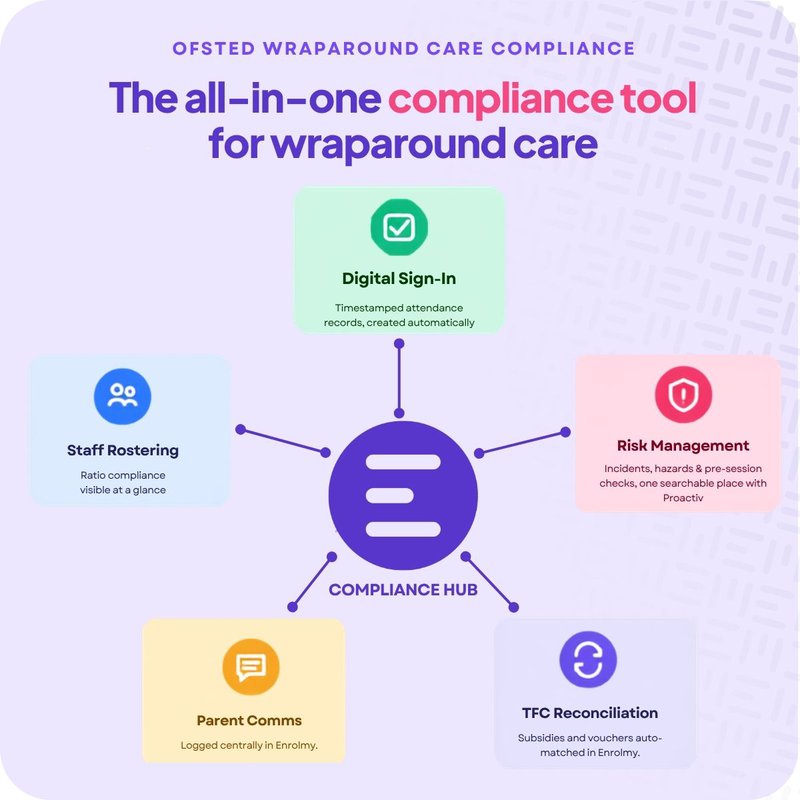
None of this replaces the human judgement at the heart of good childcare. But it does mean the evidence base you need for inspection is being built continuously in the background, rather than assembled in a rush the week before.
Frequently asked questions
How much notice will I get before an Ofsted inspection?
For most out-of-school settings on the Childcare Register or Early Years Register, Ofsted typically gives between zero and two days' notice before an inspection. In practice, many inspections are unannounced or very short notice. This is why it’s so important that your evidence is consistently main- tained rather than prepared reactively. A good rule of thumb is to treat every session as though an inspector could walk in at any time
What happens if Ofsted finds something that needs to improve?
If an inspection identifies areas for improvement, Ofsted may issue actions (requirements or recommendations) and re-inspect to check compliance. Under the new report card framework being introduced across 2025 and 2026, outcomes will be reported across multiple dimensions, so a strength in one area will not automatically offset a weakness in another. The most important thing is to engage openly with the inspector during the visit and to have a documented improvement plan ready to act on immediately afterwards.
Do I need to be Ofsted registered if I only run holiday clubs?
It depends on the ages of the children and the hours of operation.Provision for children under 8 that runs for more than two hours per day on more than 14 days per year generally requires registra- tion on the Early Years or Childcare Register. Holiday clubs that exclusively cater to children aged 8 and over are usually exempt, although other health and safety requirements may still apply. If you are unsure, Ofsted guidance on registration requirements, the Ofsted guidance on registration and the BASC code of practice are useful starting points, and it is always worth seeking advice specific to your setting.
Can I use the same risk assessment across multiple sites?
No, risk assessments must be site specific. A generic template can be useful as a starting point, but each location needs its own assessment that reflects the actual physical environment, the activities taking place, and any site-specific hazards. If you run holiday clubs at venues you do not use during term time, you should conduct a fresh assessment each time you use a new site, not simply rely on a previous year's document.
Ready to feel confident and prepared for your next Ofsted? Book a demo with our UK team →
Enrolmy is a childcare management platform supporting wraparound care providers across the UK. This post is for guidance purposes. For regulatory advice specific to your setting, consult Ofsted directly or seek support from your local authority or BASC.
Book a free demo now!
It only takes a few clicks to get started
Book DemoJoin UK wraparound care and holiday camp providers already running on EnrolMy. Book a demo with our UK team.